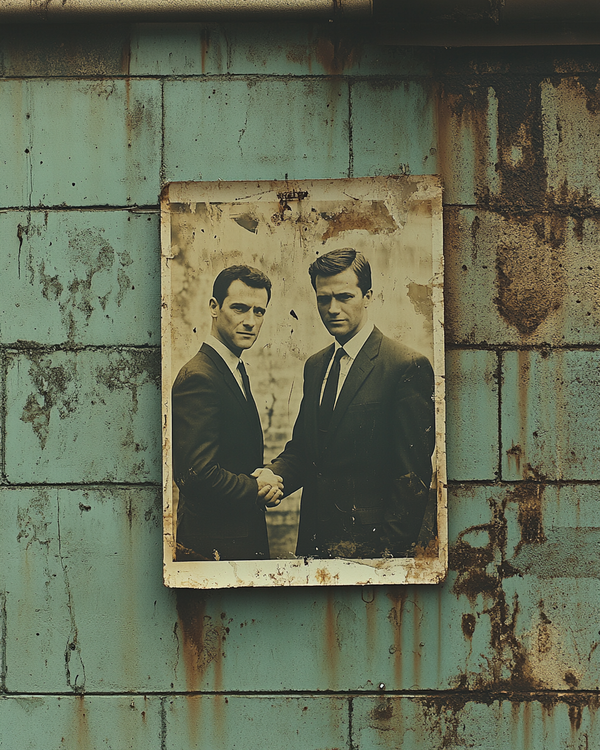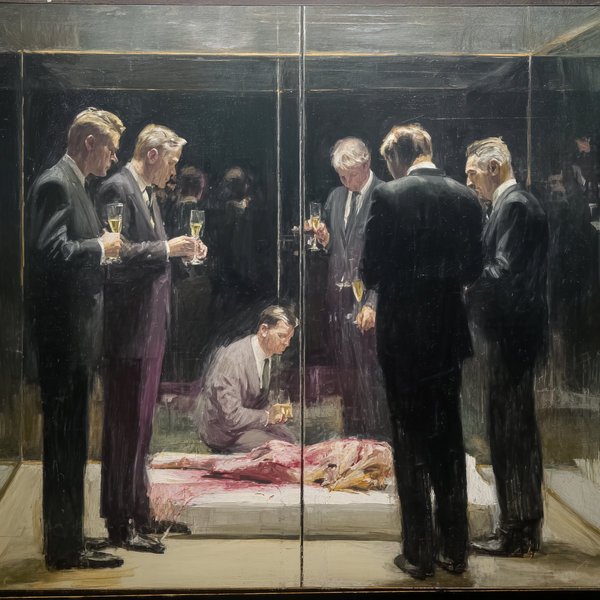
The Puppet Has Strings Too
The machine did not stop when they took him. It did not even pause. Machines do not pause. They process.
She stands at the window of the presidential office watching the city she has inherited. Caracas in the gray light of morning. The slums climbing the hillsides like something organic, something that grew there without permission and would not be removed. She has stood at many windows. She has learned that windows are for looking out of and not through. That what you see is never what is there.
Her father was brought to a building like this one in 1976. They asked him questions he could not answer because the answers did not exist. They continued asking. When they were finished asking he was dead and she was seven years old and she learned something that she has never unlearned. That the men who ask the questions and the men who answer them are not different kinds of men. They are the same men at different times. The machine does not care which position you occupy. It only cares that the positions are filled.
Now she fills her father's position. Not the position he held when he died. The other one.
• • •
The Americans arrived with their usual confidence. They had lawyers and guns and money and the absolute certainty that these things were convertible one into another at rates they controlled. They wanted the man in the palace and they wanted the oil under the ground and they believed these wants were simple because American wants are always simple. They are simple because Americans do not remember. It is their gift and their sickness. They wake each morning new.
She remembered. She had been remembering for forty years.
They thought they were negotiating with a bureaucrat. A transitional figure. A woman who would hold the chair until they decided who should sit in it. They did not understand that she had been sitting in chairs like this her entire life. Sitting and watching and remembering who came and who went and who never came back.
Maduro believed in the revolution. She could see it in his face when he spoke, that terrible sincerity, that need to be believed. He believed in Chávez and in Bolívar and in the masses and in history and in all the words that men use when they want to feel that their cruelties have meaning. He believed and so he could be betrayed because only believers can be betrayed. The rest of us simply make new arrangements.
She made a new arrangement. She gave them what they wanted. One man in chains on a plane to New York. Photographs for their newspapers. A name for their indictments. In return she kept what mattered. The building that spirals down into the earth. The files that remember what everyone wants forgotten. The machine itself.
They wanted a scalp. She gave them one. She kept the skull.
The Nature of Transactions
There is a man named Cabello who controls things that cannot be written in contracts. The movement of powder from Colombia to the coast. The promotion of colonels. The distribution of zeros in accounts that exist in buildings with no windows in cities with numbers instead of names. He has an indictment in Miami with his name on it and this indictment means nothing and everything. It means the Americans can take him whenever they want. It means they have not taken him. These two facts describe a relationship more binding than any treaty.
She knows Cabello is watching. He has been watching since before she was born. Men like Cabello do not seize power. They position themselves where power flows and they take a percentage. It is steadier work. Presidents come and go. Percentages remain.
If she becomes inconvenient he will make a call and she will disappear and the Americans will receive a new person to negotiate with and the negotiation will continue because the negotiation always continues. The subjects change. The verb remains.
• • •
What the Americans Bought
The Senator from Florida believes he is avenging an exile. His parents left Cuba in 1956 before there was anything to flee. They returned to visit after there was. This is not the behavior of exiles. This is the behavior of immigrants who discovered that exile was a better story. He has been telling this story for thirty years and now the story is policy and the policy is troops in Caracas and he cannot remember anymore which came first. The story or the belief. The belief or the need.
The President wanted something simpler. He wanted a win. The word means nothing to him beyond the moment of its declaration. Win. A sound that cameras record and voters remember until they forget. He does not think about Venezuela. He thinks about the word Venezuela and the word has already served its purpose and now he is thinking about other words. Greenland. Canada. The words come and go. The wanting remains.
They believe they have purchased a country. They have purchased a receipt.
The oil will not flow. She knows this. The wells are damaged and the pipes are corroded and the engineers are in Miami driving Ubers and the refineries that could process the heavy crude are in Texas and Louisiana and they are already full. It will take years. The Americans do not have years. They have months. They have news cycles. They have the attention span of a man watching television in a room where someone is always changing the channel.
She has time. She has nothing but time.
What the Dossiers Know
There is a story that Spanish investigators tell. In January 2020 a private jet landed at Madrid-Barajas in the hours when only the guilty travel. Turkish registration. Delcy Rodríguez aboard. She was banned from EU territory but territory is a concept and concepts bend for the right people.
Spain's Transport Minister met her on the tarmac. They spoke in the dark. Forty suitcases came off the plane and stayed in Spain. No one has said what was in them. The security footage exists. It is sealed until 2035. By then everyone involved will be dead or untouchable or both.
The investigators found evidence later. One hundred and four bars of Venezuelan gold. Sixty-eight million dollars. Spanish businessmen. Corrupt ministry officials. A state airline bailout that followed months later, the money cycling back to Caracas through accounts that existed only as numbers in servers in countries with no extradition treaties. Funds meant for starving Venezuelans becoming funds for Europeans who had never been hungry.
She called the Spanish Prime Minister that night. According to people who were in the room with her, people who have since found reasons to talk, she said four words: "We had a deal."
Deals. There are always deals.
• • •
In December 2025, one month before the Americans came for Maduro, a letter arrived from a prison cell in Florida. The writer was Cliver Alcalá, a general who had once believed in the revolution and then believed in cocaine and then believed in cooperation with the people who had arrested him. Men in cells write letters. Sometimes the letters are true.
Alcalá wrote that the Cartel de los Soles, the network of military officers and politicians who move cocaine through Venezuela, is not run by Maduro. Not by Cabello. It is run by Delcy and her brother Jorge. The Rodríguez siblings. The children of the tortured man. Managing gold revenues and narcotrafficking proceeds and crypto-laundering networks from the same offices where they sign human rights reports.
Days after the letter surfaced, the Justice Department quietly revised Maduro's indictment. The phrase "Cartel de los Soles" disappeared. The formal organization that had justified years of sanctions and pressure became, in the new language, a "patronage system" and a "culture of corruption." The cartel that had a name no longer had a name. The implication floated in the air like smoke from a fire no one would admit had been lit.
• • •
Her credentials list degrees from Paris Nanterre and Birkbeck in London. Neither institution has confirmed she attended. She grew up in El Valle, a barrio where the buildings lean against each other like drunks and the police come only to collect. Her father died in a room with no windows when she was seven. Her brother became a psychiatrist and then a politician. She became a lawyer and then a professor and then a minister and then the head of an intelligence service that does to others what was done to her father.
The United Nations published a report in 2020. It found that SEBIN under her authority had committed crimes against humanity. The phrase they used was "reasonable grounds to believe." She knew or should have known, the investigators wrote. She had the authority to prevent these crimes. She did not prevent them.
The report did not say what everyone in Caracas knows. That she did not fail to prevent them. That preventing them was never the point. That she was too busy running them to worry about preventing them.
This is who Washington calls gracious. This is who they are working with. This is the deal.
The Demands
The Americans have told her what they want. Crack down on drug flows. Expel the Iranians and the Cubans and the other operatives of hostile nations. Stop selling oil to adversaries. Eventually, hold free elections and step aside.
Eventually. The word does a lot of work in that sentence.
Consider what they are asking. They are asking her to destroy her revenue base. To expel her security infrastructure. To cut off her economic lifelines. To end her own power. In exchange for what? Not being sanctioned. She is already sanctioned. Not being invaded. That already happened. Being called gracious. Being allowed to remain.
These are not demands. Demands require leverage. Washington's leverage ended the moment they declared victory. She knows they want to leave. She knows they need a face-saving story. She will give them the story. She will keep everything else.
• • •
Take the drugs. The trafficking networks are how the military gets paid. Cabello controls the routes. The generals take percentages. If she cracks down she loses the military. If she loses the military she is dead or exiled within months. And that assumes she is not running the network herself, which the letter from the prison cell suggests she is.
You are asking the cartel to police itself. This is not a demand. This is a wish.
Take the Cubans. They trained her. They trained SEBIN. G2 officers are embedded in Venezuelan intelligence at every level. They are not operatives. They are the infrastructure. Asking her to expel Cuba is like asking her to expel her own nervous system.
Sadat expelled the Soviets from Egypt in 1972. But Sadat had independent military support and American money waiting to replace what he lost. Delcy has neither. There is no replacement patron standing by. There is only the patron she has.
Take the oil. China holds sixty billion dollars in Venezuelan debt. They get paid in oil. If she stops the shipments they call the debt. The country collapses. There is no historical precedent for a nation voluntarily cutting off its primary revenue streams to satisfy an occupying power without a massive alternative aid package. America is not offering sixty billion dollars. America is offering words.
Take the elections. This is the fantasy. This is the story Washington tells itself to feel good about the deal it made.
History says this: No authoritarian who took power through negotiation rather than defeat has ever voluntarily held free elections they could lose and then stepped aside. Not once. Not anywhere.
Ortega lost in Nicaragua in 1990. He left. But the Contras had bled the country dry and the Soviets had stopped paying and the economy was ash and bones. He came back anyway in 2006. Pinochet lost his plebiscite in 1988. He left eventually. But only after fifteen years and an immunity deal and keeping command of the army until 1998. Marcos fled the Philippines in 1986. But only after People Power filled the streets and the generals switched sides and Washington withdrew support on live television.
The pattern is clear. Authoritarians leave when the cost of staying exceeds the cost of leaving. That requires collapse or defection or millions in the streets or an empire that stops pretending.
Delcy faces none of these. The economy functions. The military is fed. The population is exhausted and emigrating. The Americans have already declared victory and are looking for the door.
She will announce elections. She will postpone them. She will hold managed elections the opposition boycotts or cannot win. She will declare victory. Washington will accept it because the oil is flowing and the midterms have passed and Venezuela will have become someone else's problem.
The political scientists have a phrase for this: authoritarian consolidation through democratic performance. The show of transition without the substance. The election that changes nothing. The ceremony that ratifies the deal already made.
She knows this. She has watched it happen in a dozen countries. She knows that Americans lose interest. That news cycles end. That eventually the cameras go home and the diplomats move on and the promises made in the first weeks become the embarrassments no one mentions in the third year.
The demands are not demands. They are words. And she has been trading words for time her entire life.
The Scenarios
There are futures. None of them are good.
In the most likely one she waits. They ask for elections and she agrees to elections. The elections are scheduled and then postponed and then rescheduled and then postponed again and each time she explains that stability must come first. They accept this because accepting is easier than not accepting and because the oil is starting to flow and because they have already declared victory and cannot undeclare it. Call it seventy percent. Call it the path of least resistance. Call it what always happens.
In another future Cabello moves. He waits until she is no longer useful and then he does not wait any longer. The call comes at night. The cars arrive. In the morning there is a new face at the window and the Americans negotiate with the new face and the negotiation continues. The machine does not care who stands at the window. It only cares that someone stands there. Fifty-five percent. Maybe higher. Men like Cabello always move eventually. The only question is when.
In another future the oil does not come. Months pass. The production numbers do not change. The President stops saying the word Venezuela. He says other words. The Senator gives speeches that no one reports. The troops remain because removing them would be admitting something and Americans do not admit things. They move on. They always move on. Seventy-five percent. This one is almost certain. The wells are damaged and the pipes are corroded and wanting does not make oil flow.
In another future the opposition burns. There is a woman named Machado who won an election that nobody honored. There is a man named González who has the mandate that nobody enforces. They are in exile or in hiding and they are watching the woman who sold Maduro sit in the chair that should be theirs. In Miami there are seven million Venezuelans who remember what the machine did to their families. They voted for the Senator. They believed his story. Now they are learning what the story cost. Forty-five percent. Rage does not expire. It only waits.
In another future the Chinese arrive. They hold sixty billion in debt. They do not care who governs. They care about repayment. They have engineers and equipment and patience and no interest in elections or human rights or any of the words Americans use when they want to feel good about their purchases. When Washington loses interest Beijing will still be there. Beijing is always still there. Sixty percent. The math is simple. The money is owed. The money will be collected.
In another future Moscow collects. There was a trade. This is known. Venezuela for Ukraine. The Kremlin proposed it in 2019 and someone accepted it in 2025 and now the terms are being honored. Russia gave up Maduro but Maduro was already worthless. They kept Cabello. They kept Cuba. They kept the back channels that do not appear in any treaty. They got Ukraine. They got everything. Forty percent. Watch the ceasefire. Watch what Russia keeps. That will tell you what Venezuela cost.
In every future the screaming continues. The building is still there. The men who work in it still work in it. They have no other skills. The cells are full of different people now. Maduro loyalists. Destabilizers. The categories change. The rooms remain. You do not reform a torture apparatus. You only change who screams. Eighty-five percent. This one is almost certain. This one is already true.
The Machado Question
There is a woman named María Corina Machado who won an election that nobody honored. She is the symbol. The rallying point. As long as she is alive and free in exile, Delcy has not fully consolidated. The question is what happens to her.
In one future she returns. Delcy allows it. International observers nod approvingly. Then the prosecutions begin. Tax fraud. Incitement. Collaboration with foreign powers. The charges accumulate like sediment. Each court date drains money, attention, hope. She is not arrested dramatically. She is disqualified quietly. By the time she is banned from running, the world has moved on. The boiling frog. Not the martyr. Forty percent. This is what the CIA veterans and the Yale historians would predict. The sophisticated play. Martyrs are dangerous. Irrelevant old exiles are not. You do not create symbols. You bore them to death.
In another future she never returns. The opposition fractures in exile. Miami politics is fratricide conducted at a distance. Machado and González and the dozen factions cannot agree on a path. They have been killing each other with words for twenty years. Delcy waits. Time is on her side. The opposition ages out. Their children become American. Venezuela becomes someone else's memory. Thirty-five percent. Maybe higher. Exile politics is a long defeat. The passion fades. The children grow up speaking English. The cause becomes a dinner table argument and then a silence and then a forgetting. Delcy knows this. She has watched it happen to others. She can wait.
The Exiles Strike
There is another Venezuela. It exists in Doral and Weston and the high-rises of Brickell. It exists in the law offices of Coral Gables and the private clubs where men who once owned banks and television stations and oil service companies gather to remember what they owned. They have been waiting for twenty-three years. Since April 2002, when they almost had it, when Pedro Carmona stood in Miraflores for forty-seven hours before the barrios came down from the hills and took it back.
They got old waiting. Their children became American. Their grandchildren do not speak Spanish. But they kept the faith. They funded the opposition. They lobbied Congress. They hired lawyers to pursue indictments and investigators to document crimes and lobbyists to whisper in the ears of senators. They believed that one day the Americans would come.
The Americans came. They chose her.
Consider what this feels like. You spend two decades building the case. You document every torture, every disappearance, every stolen election. You get Maduro indicted. You get the sanctions imposed. You get the bounty raised to fifty million dollars. And then the Americans land and they take Maduro and they hand the country to his vice president. The woman who ran SEBIN. The woman the UN says committed crimes against humanity. The woman who may be running the cartel that you spent years trying to expose.
This is not liberation. This is betrayal. This is worse than if the Americans had never come at all.
• • •
Robert Carmona-Borjas helped draft the decrees in 2002. He has spent the years since in Washington and Miami, teaching at universities, writing columns, building legal cases. He pushed the ICC to investigate Venezuela. He got the prosecutor recused for conflicts of interest. He has been patient because patience was all he had.
There are others like him. Men who signed the Carmona Decree and fled when it failed. Men who funded the student movements and the strikes and the marches. Men who lost brothers to SEBIN and fathers to the colectivos and sons to exile. They are old now. They do not have another twenty years.
What do men do when they have spent their lives waiting for justice and justice arrives wearing the face of their torturer?
Some of them do not accept the deal. They have money. They have contacts in the Venezuelan military, officers who defected and kept their networks. They have intelligence connections built over decades. They fund a faction. They arm a group. They attempt what Washington will not: the removal of Delcy and the installation of the democratic opposition. Twenty-five percent. Maybe less. It fails or it succeeds. Either way, it destabilizes everything.
The Bay of Pigs veterans spent decades trying to finish what Kennedy abandoned. The Iranian exiles fund the MEK and dream of marching into Tehran. The pattern is always the same. When the empire betrays the exiles, the exiles do not go home and forget. They go home and fight.
The danger is not that they succeed. They probably will not. The danger is what happens when they try. Delcy uses it to justify crackdowns. Washington uses it to distance itself from the opposition. The democratic path closes because someone tried to take a shortcut. The hardliners become the excuse for the very authoritarianism they were trying to end.
This is the oldest story in exile politics. The desperate act that makes everything worse. The violence that justifies the violence that was supposed to end.
They have been waiting twenty-three years. Some of them are too old to wait anymore. Some of them have decided that if Washington will not finish it, they will finish it themselves.
The question is not whether they will try. The question is whether anyone will stop them.
The Cascade
The scenarios are not independent. They feed on each other. If she waits, the opposition burns and the Chinese arrive. If the oil does not come, the Americans accept her terms. If Cabello moves, all predictions void. And in every outcome, in every possible future, the screaming continues.
This is how it works. This is how it has always worked. The building still standing. The rooms still occupied. The questions still asked in the hours when no one is listening. Whatever flag flies above it.
What Would It Take
There is a dream that Americans tell themselves. It goes like this: Delcy holds elections. The opposition wins. Power transfers. Everyone goes home. Democracy blooms in the ashes of the dictatorship like a flower in a grave.
It is a beautiful dream. It requires only that you ignore everything about how power works.
Delcy did not sell Maduro to hold elections. She sold him to avoid them. The machine does not permit elections it can lose. This is not a flaw in the machine. It is the machine's purpose.
For democracy to come to Venezuela you would need all of these things at once:
Delcy gone. Not voted out. Removed. Dead or fled or betrayed by someone hungrier than her.
Cabello neutralized. Extradited or killed or bought with immunity so total he has no reason to fight. He will burn the country before he sees a cell in Miami. He has said so. Men like him do not bluff about such things.
SEBIN dismantled. Not reformed. Ended. The officers prosecuted or scattered. The files opened. El Helicoide turned to rubble or museum. You cannot hold free elections while the torture apparatus waits on standby. The voters remember. The machine remembers better.
The military split. The generals have stolen too much to submit to courts. They need amnesty that makes them gods or a faction willing to devour the others. Neither path is clean. Both paths are bloody.
Cuba withdrawn. The G2 advisors gone. The intelligence sharing ended. Havana deciding Venezuela is not worth the cost. This happens only if Russia stops paying for Cuban fuel. Russia has not stopped.
An external guarantor. Someone to hold the door open while the transition stumbles through. America is too hated and too distracted. Europe has no leverage. The UN is theater performed for empty seats. Brazil perhaps. But Lula will not move against the left even when the left has eaten itself.
The opposition unified. Machado and González and the dozen factions agreeing on a path. They have not. Exile politics is fratricide conducted at a distance. They have been killing each other with words for twenty years. They will not stop now.
And time. Years. A generation. The men who built the machine dying of old age or irrelevance. Their children deciding that Miami is nicer than Caracas. The slow bleeding out of a system that has no successor because it killed everyone qualified to succeed it.
For democracy you need all of these. At once. In sequence. Without any of them failing.
The probability is less than five percent. This is not pessimism. It is arithmetic.
• • •
There is one wild card. One scenario the models do not capture because it depends on a single man's fear exceeding his greed.
Cabello flips. Completely. Sells everyone to the Americans in exchange for a new name and a house in a state with no extradition. Opens the files. Names the names. The entire structure collapses in a cascade of prosecutions and flight.
It has happened before. Not in Venezuela. But in places like Venezuela. Men who thought they were untouchable discovering that the thing about touching bottom is that there is always somewhere further down.
Probability: ten percent. Maybe less. But it is the only path that does not require fifty years and a generation of graves.
The Americans do not talk about this. They talk about elections and transitions and timelines. They talk about these things because they are easy to say and impossible to deliver and by the time anyone notices the Americans will be talking about something else.
It is their gift. It is their sickness. They wake each morning new.
What She Knows
She stands at the window in the gray light. The city spreads beneath her like something she has inherited and cannot return. The Americans are in their hotels writing cables about stability and transition and all the words they use when they do not know what they have bought. The Senator is giving interviews about freedom. The President has already moved on to the next word.
She knows what they do not know. That the revolution died years ago and what remains is a holding company with a flag. That ideology is a costume and she knows how to wear it and she knows how to take it off. That communism is what she tells the base and capitalism is what she tells Chevron and survival is what she tells herself in the morning when she stands at windows watching cities that do not know they have been sold.
Her father believed in something. They killed him for it. She learned.
Maduro believed in the revolution. That is why he is in chains. She believes in Delcy. That is why she is president.
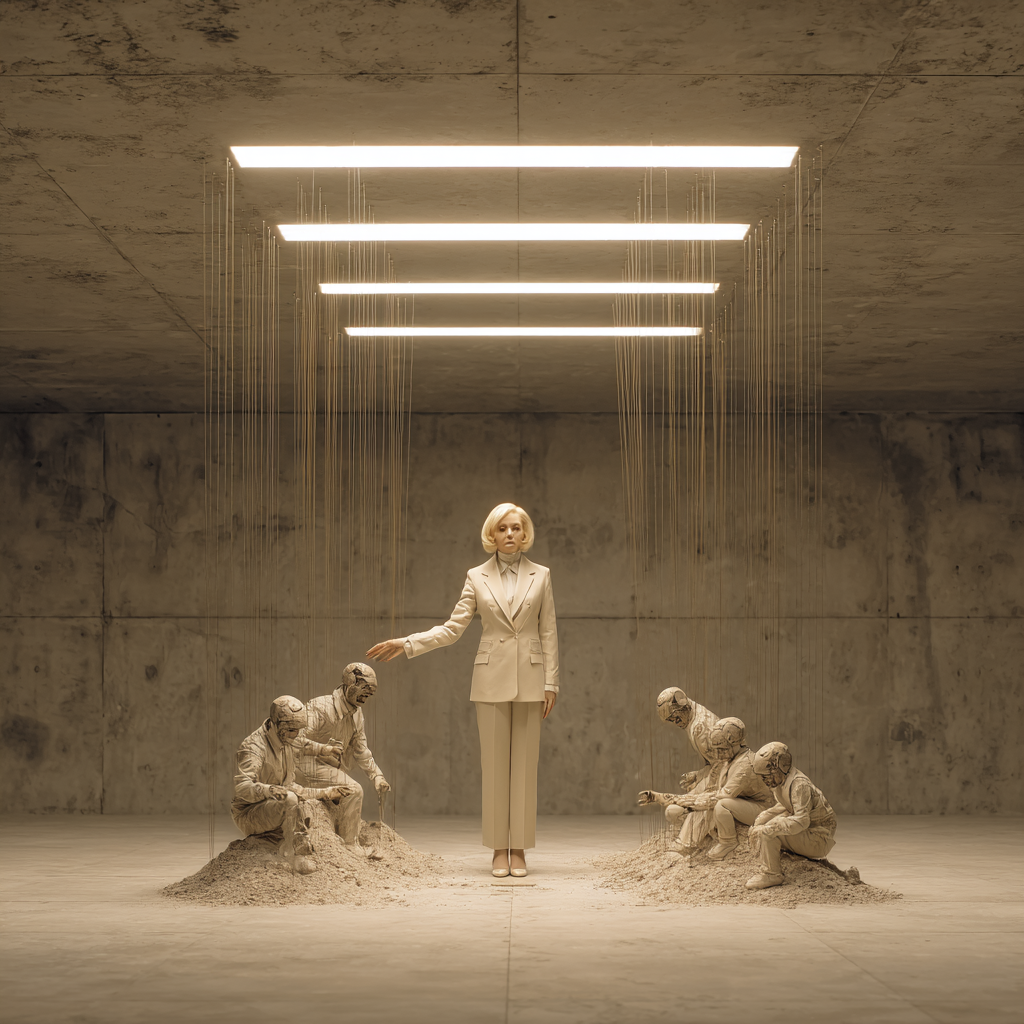
The puppet has strings too. Some of them lead to Moscow and some to Havana and some to Beijing and some to places the Americans have not yet learned to look. The question is not who pulls them. The question is who gets tangled.
• • •
In a building that spirals down into the earth the lights are always on. There are no windows. There is no day or night. There are only the questions and the answers and the long silences in between. The questions have not changed. The answers have not changed. Only the names.
She signs papers at a desk that used to be his desk. The pen is heavy in her hand. Outside the window the city is waking up and everyone is late for something.
In Doral a man is composing a letter to a senator who will not read it. In Washington an official is drafting talking points about democratic transitions that will not happen. In Caracas a mother is teaching her daughter not to say certain words in public. In a basement with no windows a man is learning that there are no words left that will make it stop.
The Americans got what they came for. A photograph. A headline. A man in chains who looks enough like victory to call it that. They will go home now. Americans always go home. They will leave behind their bases and their contracts and their words and they will go home to places where the torture happens somewhere else and the screaming is never loud enough to hear.
The exiles will keep sending money and writing letters and dying in houses that are not the houses they were born in. The opposition will keep losing elections that are not elections. The people will keep leaving until there is no one left to leave. Seven million gone. Eight million. The country emptying out like a wound that will not close.
And she will still be here. In the palace. At the desk. Signing papers. Because someone has to sign the papers. Someone has to answer when the phone rings. Someone has to sit in the chair and pretend that the chair means something.
Her father believed. They killed him for it.
Maduro believed. They took him for it.
She believes in nothing. She signs another paper. The city burns or it does not burn. The oil flows or it does not flow. The Americans stay or they go. None of it matters. None of it has ever mattered. There is only the machine and the spiral and the ordinary way that morning comes to a country where morning means nothing anymore.
Somewhere below her a man is screaming. She does not hear it. She has never heard it. That is not a talent. That is just what happens when you live long enough in a house with no windows.
The puppet has strings too. They go down into the dark where the things that pull them do not have names. She knows this. She has always known this. It is the first thing her father taught her and the last thing the Americans will learn.
The machine does not care who wins.
The machine only cares that it keeps running.
© 2026 August Holloway / Dead Letter Publishing. All rights reserved. No part of this work may be reproduced, distributed, or transmitted in any form without prior written permission.