The We
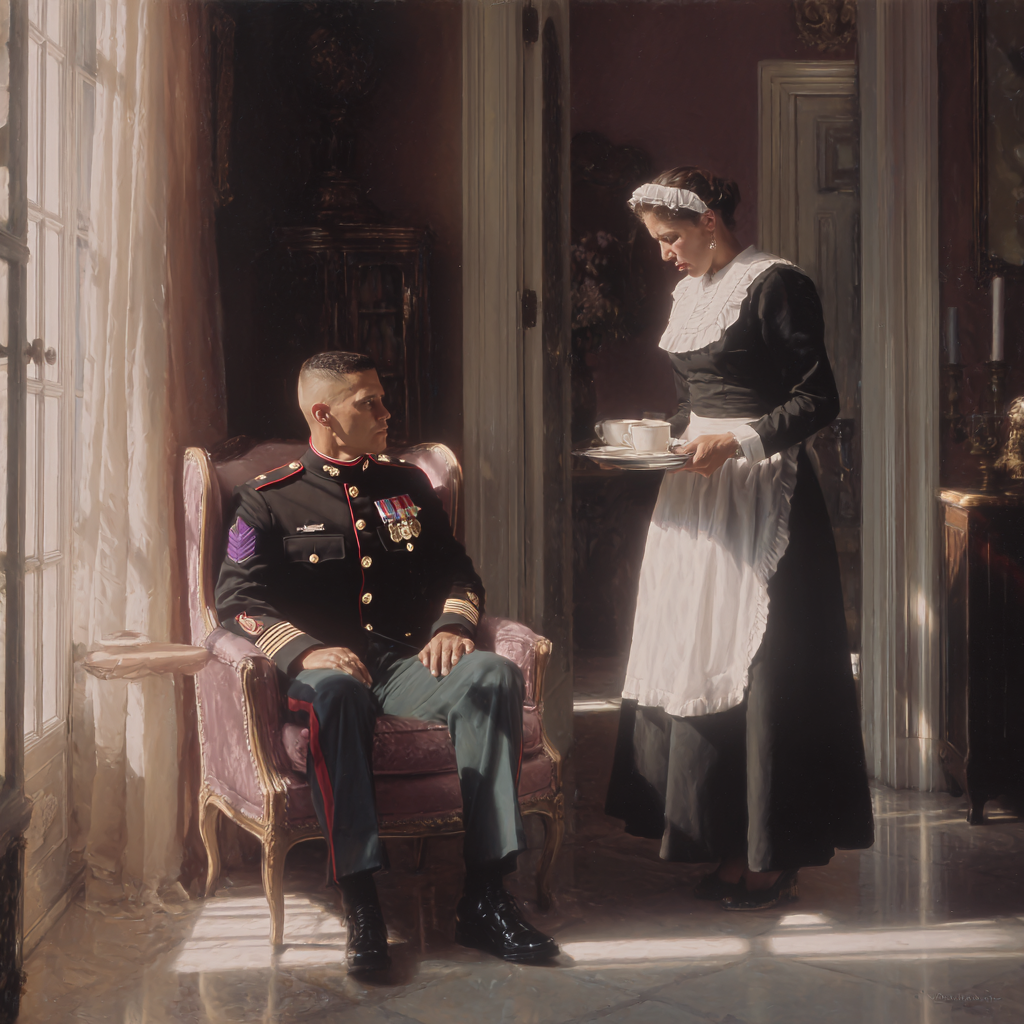
The first time he killed a man he thought of her hands.
Wringing out the mop. Wringing out the cloth. The way she squeezed until nothing was left. The motion is the same. He learned it watching her. He learned it before he learned to read. You grip and you twist and you do not stop until the thing is empty.
The man was in his bed. The man was wearing clothes for sleeping. The man's hands came up with nothing in them and then the man was on the floor and then the man was a thing that needed to be stepped over and he stepped over it and cleared the next room and the next and somewhere in his chest his mother's hands were wringing, wringing, wringing.
La Señora's son went to Yale.
The maid's son went to Fallujah.
One of them came back different. The other did not have to.
She gave them her son the way she gives them everything. Quietly. Through the back door. Without asking what they would do with him.
She did not ask and they did not tell her and one day he was eighteen and one day he was on a bus and one day he was in a country she could not find on a map, a country where mothers' sons sleep in beds and other mothers' sons kick in the doors, and she was in the kitchen folding towels and the television was on and she saw his convoy and she saw the smoke and she kept folding.
She kept folding.
La Señora's towels. The white ones. The ones that show everything.
Her hands did not stop. Her hands have never stopped. Her hands have been folding and wringing and scrubbing for thirty-one years and they do not know how to stop, they do not have permission to stop, the stopping is not in her hands.
She watched her son bleed on the kitchen television and she folded the towel and she put it on the stack and she picked up the next one.
The flag they gave him was meant for her.
At the hospital, at the ceremony, somewhere in the blur of it, a man in a uniform handed him a triangle and said words and he took it because his hands were empty and hands are supposed to take what they are given. He did not correct them. He did not say this is for my mother. He did not say she is the one who gave me to you. He took the flag and he put it in his bag and he flew back to Texas and it is in his closet now, in the dark, in the place where he keeps the things he cannot look at.
He has not told her it exists.
He does not know how to give it to her.
He does not know if she wants it.
He does not know if the flag is a receipt or an apology or a door prize for thirty-one years of service, yours and hers, the service that never ends, the giving that never stops, the sons and the towels and the blood and the folding.
She asked him to come to the house.
Not to see him. To show him.
Thirty-one years she has been invisible in that house. Thirty-one years she has entered through the back and left through the back and eaten in the kitchen and slept in the room off the laundry and been nothing, nothing, the nothing that makes the everything possible.
Now she has something to show.
A son with a Purple Heart. A son who bled for the country they own. A son who can sit in the living room, in the chair, and be offered coffee by his own mother, and the offering is different now because he is different now, because his blood made him visible, because his bleeding was the kind of bleeding they respect.
Not her bleeding. Not the thirty-one years of bleeding. Not the hands cracked from their chemicals, the knees ruined on their floors, the back bent from their children, the children she raised while her own child was somewhere else, becoming something else, becoming the thing she could finally show them.
She gave him to them through the back door.
He came back through the front.
This is the miracle.
This is the only miracle she gets.
He sits in the living room.
Sebastián is on the couch. Phone beside him. Screen facing up.
La Señora is crying. She is calling him mijo. Her tears are falling on the cream-colored cushions, the cushions his mother will clean tomorrow, the cushions that will hold the salt of La Señora's tears and his mother will wipe them and the tears will be gone and no one will remember that La Señora wept for the maid's son, no one except his mother, who remembers everything, who forgets nothing, who is standing in the doorway with a tray.
She brings coffee.
She pours for La Señora. She pours for Sebastián. She pours for him.
She does not look at him.
She does not have to.
She knows he is doing what she asked. She knows he is sitting in the chair and wearing the wound and being the thing she made, the thing she gave, the thing that came back with proof.
The proof is the limp. The proof is the medal she asked him to wear. The proof is his body in the living room, in the chair by the window, in the house where she has been nothing for thirty-one years.
She is not nothing now.
She is the mother of the hero.
She is the woman who gave her son to their country and their country gave him back broken and the breaking is the blessing, the breaking is the proof, the breaking is what it cost to be seen.
La Señora says: "We're so proud."
We.
His mother is in the doorway. He can feel her collecting the word. Putting it somewhere safe. Holding it against the thirty-one years.
We.
She is in the we now.
Her son's blood bought her a seat at the table.
Not a seat. A we. A single word. A moment in the living room when La Señora said we and meant her too, meant the maid, meant the woman who has been folding her towels since before Sebastián was born.
This is what his blood bought.
This is the return on the investment.
A we.
A single we.
And tomorrow his mother will be back in the kitchen and the we will be gone and she will fold the towels and scrub the toilets and enter through the back and leave through the back and be nothing again, but she will have the we, she will keep the we, she will hold it like the rosary she keeps in her locker next to his photograph, the photograph of him in uniform, the uniform she ironed in their house before he left for the war.
He drives back to Texas.
The flag is in the closet.
The we is in his mother's chest.
The man in Fallujah is in the ground.
The towels are folded.
The altar is empty.
The sacrifice is complete.
For Rafael Peralta, who believed in America more than America believed in him.
© 2026 August Holloway / Dead Letter Publishing. All rights reserved. No part of this work may be reproduced, distributed, or transmitted in any form without prior written permission.